We've compiled a list of 24 free and paid alternatives to TextPad. The primary competitors include Notepad++, Vim. In addition to these, users also draw comparisons between TextPad and Visual Studio Code, Brackets, TextMate. Also you can look at other similar options here: Development Tools.
We've compiled a list of 24 free and paid alternatives to TextPad. The primary competitors include Notepad++, Vim. In addition to these, users also draw comparisons between TextPad and Visual Studio Code, Brackets, TextMate. Also you can look at other similar options here: Development Tools.
Notepad++ is a free text editor that supports color-coded syntax highlighting for different programming languages, auto-completion, the ability to open different tabs with different files at the same time, and support for plugins to extend functiona…
Visual Studio Code is a versatile code editor tailored for modern web and cloud app development. It's free, cross-platform, and boasts a rich ecosystem of extensions.
Brackets is a cutting-edge, open-source code editor tailored for web design. It seamlessly integrates visual tools for efficient CSS, HTML, and Javascript coding. With frequent updates and extensions, Brackets enhances productivity, offering a Quick…
Oxygen XML Editor is a tool for visual editing of XML documents, displaying both XML tree and text formats. It provides robust support for validating XML schemas and DTDs. Advanced search and replace features simplify document editing.
QuillBot's AI-driven paraphrasing tool effortlessly refines text, enhancing clarity and comprehension by providing options for rewriting, editing, and tone adjustment. Elevate your writing with ease!
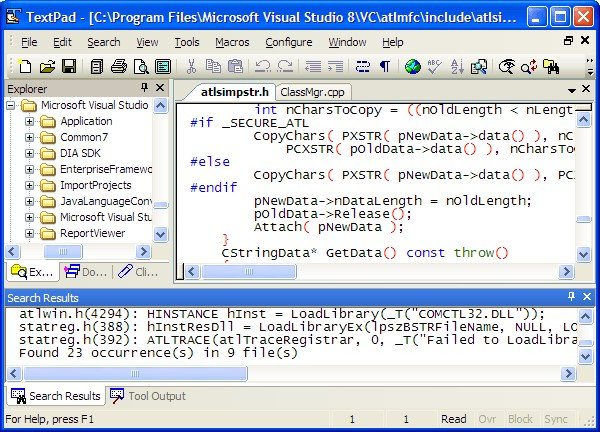
TextPad is designed to provide the power and functionality to satisfy the most demanding text editing requirements. It can edit files up to the limits of virtual memory, and it will work with the 32-bit and 64-bit editions of Windows 7, Vista, XP, 2000, Server 2003 and 2008.
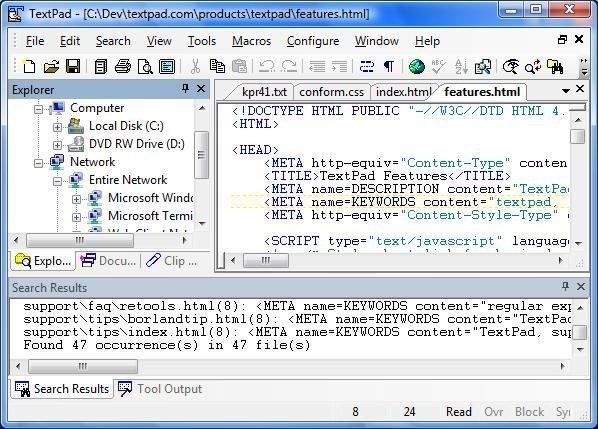
TextPad has been implemented according to the Windows XP user interface guidelines, so great attention has been paid to making it easy for both beginners and experienced users. In-context help is available for all commands, and in-context menus pop-up with the right mouse button. The Windows multiple document interface allows multiple files to be edited simultaneously, with up to 2 views on each file. Text can be dragged and dropped between files.
In addition to the usual cut and paste capabilities, you can correct the most common typing errors with commands to change case, and transpose words, characters and lines. Other commands let you indent blocks of text, split or join lines, and insert whole files. Any change can be undone or redone, right back to the first one made. Visible bookmarks can be put on lines, and edit commands can be applied to lines with bookmarks.
Frequently used combinations of commands can be saved as keystroke macros, and the spelling checker has dictionaries for 10 languages.
It also has a customizable tools menu, and integral file compare and search commands, with hypertext jumps from the matched text to the corresponding line in the source file (ideal for integrating compilers).